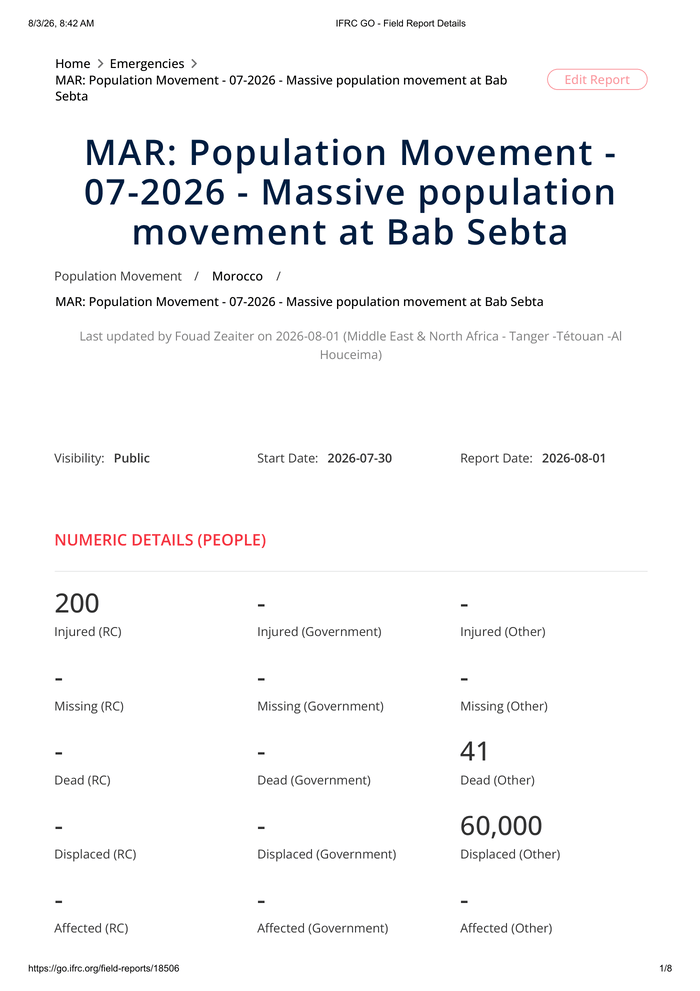
MAR: Population Movement - 07-2026 - Massive population movement at Bab Sebta (2026-08-01)
## **Description** ## 1. Executive Summary An exceptional population movement toward the Bab Sebta (Ceuta) border crossing has generated significant humanitarian needs on the Moroccan side of the border. The situation escalated rapidly between 30 and 31 July 2026, resulting in a major migration, hum
Document PDF
Télécharger
## **Description** ## 1. Executive Summary An exceptional population movement toward the Bab Sebta (Ceuta) border crossing has generated significant humanitarian needs on the Moroccan side of the border. The situation escalated rapidly between 30 and 31 July 2026, resulting in a major migration, humanitarian, and security crisis affecting both Morocco and the Spanish autonomous city of Ceuta. According to reports from the Moroccan Red Crescent (MRC) on ground, local information and international media sources, tens of thousands of people have gathered in and around Fnideq and attempted to enter Ceuta by sea and land. Spanish authorities have deployed military reinforcements, while Moroccan security forces have strengthened border controls and crowd management measures. The humanitarian impact includes fatalities, injuries, food and water shortages, psychosocial distress, and protection concerns among vulnerable groups. The Moroccan Red Crescent, as an auxiliary to the public authorities, is well positioned to support the response through health and first aid services, WASH, food assistance, protection, psychosocial support, restoring family links (RFL), community engagement and accountability (CEA), and logistics. ## 2. Background Ceuta is a Spanish autonomous city located on the northern coast of Africa and bordering Morocco. Together with Melilla, it constitutes the European Union's only land border with Africa. The area has historically served as a migration route for individuals seeking entry into Europe. Since late July 2026, a substantial increase in migration movements originating from northern Morocco, particularly the Fnideq area, has evolved into a major cross-border humanitarian emergency. Large numbers of migrants have attempted to enter Ceuta by swimming around border barriers or by approaching land crossing points. ## 3. Current Situation The situation deteriorated significantly on 30 and 31 July 2026. Spanish authorities deployed additional police and military personnel to Ceuta to restore order and manage the influx. Moroccan authorities simultaneously reinforced security deployments around Fnideq and key border crossing points. Crowd control measures, including water cannons and dispersal operations, have been reported near the border area. Large crowds continue to gather around the border area, and migration attempts remain ongoing despite heightened security measures. ## 4. Population Movement Overview Migration figures remain fluid and continue to evolve. ### Reported Figures Indicator Estimated Figure Total persons involved in the influx 60,000 expected to be higher Persons reportedly entering Ceuta during the crisis Up to 60,000 expected to be higher Persons reportedly returned to Morocco More than 25,000 expected to be higher Adult males 85-90% Adult females 5-8% Children and minors 3-7% Unaccompanied minors Presence confirmed ### Observations - Spanish authorities and Ceuta regional officials estimate at60,000 people may have crossed into Ceuta by land and sea during the crisis period. Numbers may increase. - More than 25,000 individuals have reportedly already returned or been returned to Morocco. Numbers may increase. - Field observations by the Moroccan Red Crescent indicate that arrivals remain ongoing and that the exact number of affected persons cannot yet be fully determined due to the continuous influx. ## 5. Humanitarian Impact ### Casualties Available information suggests a severe humanitarian impact. Indicator Estimated Figure Fatalities 41 reported Injured Persons Several dozen confirmed; assessment ongoing \*International media have reported 41 confirmed fatalities, while field-based operational reporting indicates figures may be higher and remain under verification. Most fatalities are reportedly linked to drowning incidents or crowd-crush events near crossing areas. #### Reported Injuries Field teams report: - Open wounds and lacerations; - Fractures of upper and lower limbs; - Exhaustion and dehydration; - Injuries linked to swimming attempts and crowd movement. The total number of injured persons remains under assessment. ## 6. Moroccan Red Crescent Field Observations The Moroccan Red Crescent has reported: - Significant numbers of individuals presenting with cuts, fractures, and physical trauma related to attempted sea crossings. - Insufficient access to food among newly arrived populations. - Limited access to safe drinking water. - Continuous arrivals from other parts of Morocco, increasing pressure on local response capacity. - Elevated levels of stress and psychosocial distress among migrants and their families. - Presence of vulnerable groups including women, children, and unaccompanied minors. ## 7. Multi-Sectoral Needs Analysis Sector Key Findings Priority Proposed Actions Health & First Aid Trauma, fractures, dehydration, exhaustion Very High Mobile clinics, first aid posts, ambulances, trauma kits WASH Limited access to drinking water Very High Water distribution, water points, hygiene kits Food Security Lack of food and emergency rations Very High Hot meals and emergency food distributions Shelter Temporary accommodation needs Very High Tents, blankets, essential household items Protection & PGI Women, children, vulnerable groups at risk Very High Identification, referral, protection services MHPSS Acute stress and psychological distress High Psychological First Aid and psychosocial support RFL High risk of family separation High Family tracing and RFL services CEA Misinformation and rumours circulating High Community engagement, awareness messages, feedback mechanisms Logistics Rapid consumption of relief stocks Very High Pre-positioning and reinforcement of relief supplies ## 8. Security and Operational Outlook The situation remains highly volatile and is characterized by: - Continued arrivals and attempted border crossings. - Large crowd concentrations around Fnideq and the Ceuta border area. - Significant military and police deployments on both sides of the border. - Traffic disruptions and localized movement restrictions. - Risks of stampedes, crowd incidents, and accidental exposure to security operations. - Potential deterioration should migration attempts continue at the current scale. ## 9. Target Population (Planning Scenario) For the initial response phase, the Moroccan Red Crescent proposes a planning scenario targeting up to 8,000 people requiring immediate humanitarian assistance. This figure should be adjusted following rapid assessments and verification of needs on the ground. ## 10. Proposed Operational Strategy The proposed response includes: - Deployment of first aid and emergency health teams. - Establishment of medical and first aid points. - Distribution of safe drinking water. - Distribution of emergency food assistance. - Implementation of Protection, PGI, MHPSS, RFL, and CEA activities. - Conducting a Rapid Multi-Sector Needs Assessment (MSNA). - Strengthening logistics, volunteer management, and coordination mechanisms. - Supporting authorities and humanitarian partners through auxiliary action in line with Red Cross Red Crescent principles. ## 11. Main Operational Risks - Continued influx of migrants. - Evolving and incomplete population data. - Security and access constraints. - Limited operational resources. - Adverse weather and maritime conditions. - Increased pressure on local humanitarian and public services. ## 12. PMER The response should include: - Daily situation reports. - Tracking of beneficiaries reached. - Regular review of assumptions and planning figures. - Monitoring of sectoral indicators. - Ongoing operational assessments and lessons learned documentation. ### **Request For Assistance** Government Requests International Assistance: **No** NS Requests International Assistance: **No** ### **Information Bulletin Published** No ### **Actions taken by National Society** **Summary** No action has been taken at this stage besides gathering information and preparing in case of needing to engage ### **Actions taken by Federation** **Summary** No action has been taken at this stage besides gathering information and preparing in case of needing to engage ### **Actions taken by RCRC** **Summary** No action has been taken at this stage besides gathering information and preparing in case of needing to engage ### **Actions taken by others** Government of Morocco Moroccan authorities have significantly reinforced security measures in and around Fnideq, Bab Sebta, and key border crossing points to prevent further irregular crossings into Ceuta. Security forces reportedly deployed crowd-control measures. Increased police and security deployments have been observed across the affected area, with efforts focused on controlling movement towards the border and maintaining public order. Government of Spain Spain deployed military personnel and additional police forces to Ceuta to reinforce border management, maintain public order, and support ongoing humanitarian and security operations. Spanish authorities launched accelerated return procedures for migrants who entered Ceuta irregularly. As of 31 July, more than 25,000 individuals had reportedly returned or been returned to Morocco. Senior government officials, including Prime Minister Pedro Sánchez and the Minister of Interior, visited Ceuta to assess the situation and coordinate the response. United Nations and International Organizations Humanitarian agencies and protection actors are closely monitoring the situation. Coordination with humanitarian partners is expected to increase should population movements continue and humanitarian needs escalate on either side of the border. Red Cross Red Crescent Movement The Moroccan Red Crescent (MRC) has conducted field observations and preliminary assessments in the affected area to identify urgent humanitarian needs and response gaps. The Spanish Red Cross is supporting humanitarian efforts in Ceuta, including assistance to vulnerable migrants and support to local authorities responding to the influx. The IFRC and relevant regional structures are monitoring developments and maintaining communication with Movement partners regarding potential humanitarian implications and response options.